Neuroscience and AI researcher, small business owner in Fort Wayne, Indiana. Founder of ICSAC, owner of 3Rivers WebTech, creator of CiteStamp. Stereotypical dad.
I'm a researcher in Fort Wayne, Indiana — complexity science, information theory, neuroscience. No university, no grant, no committee deciding what I work on. I came to it from healthcare: nursing assistant up through nursing-home administration and ICU admissions, years of watching people cross the line between conscious and unconscious. I was asking what keeps a pattern alive long before I had the math for it.
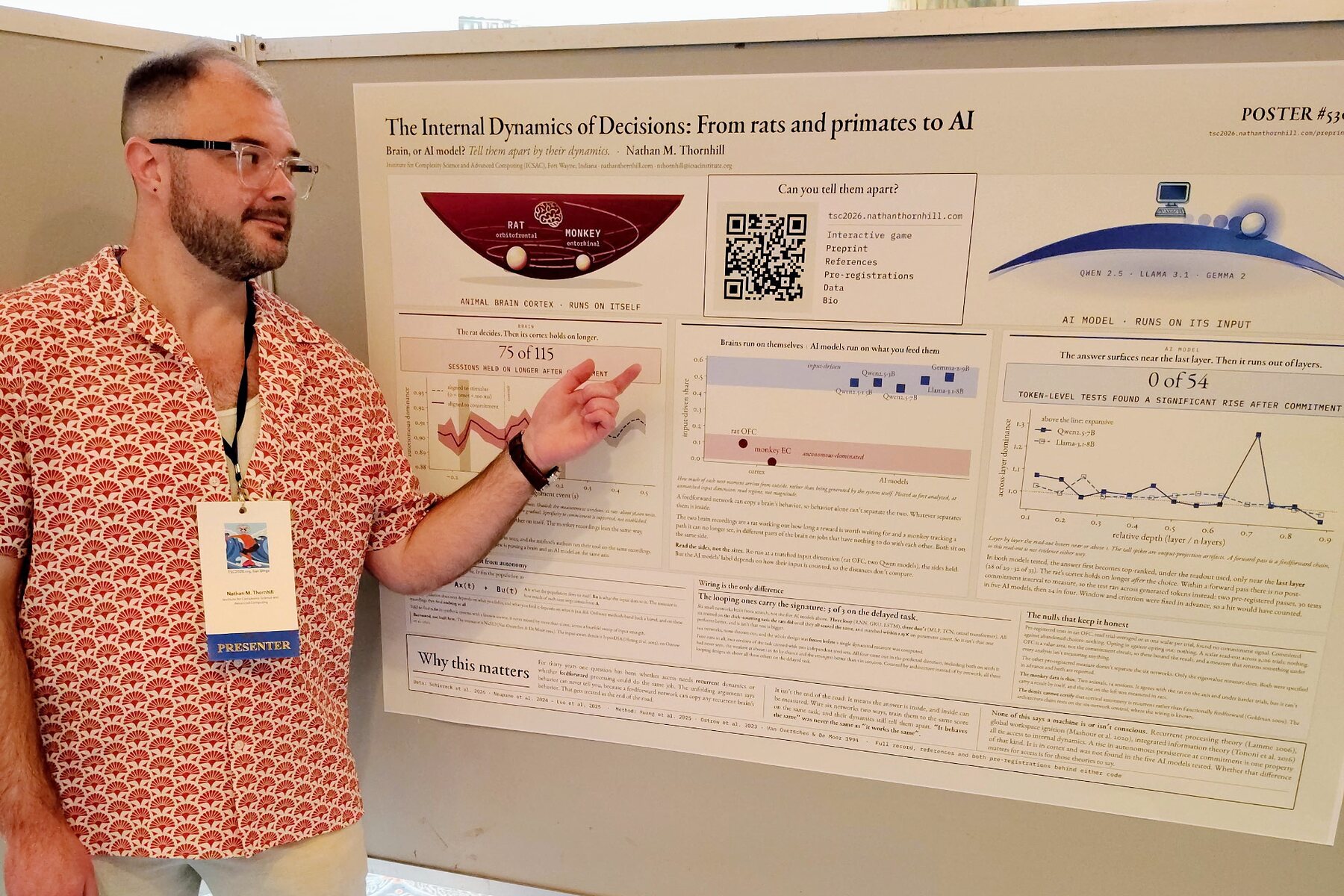
My newest paper, The Internal Dynamics of Decisions, splits a population’s activity into the part its inputs drive and the part it generates itself, then runs that same measurement on cortex from rats and primates and on AI models doing analogous work. They land in different regimes. Where I re-checked that at a matched input dimension, the direction held. After an animal commits to a choice, its cortex’s own dynamics hold on a little longer. It’s sharper lined up on the commitment than on the stimulus, though how specific it is to the commitment isn’t pinned down yet. I didn’t find that rise in any of the models. A separate control that changes only the architecture carries the recurrent-versus-feedforward claim. And in orbitofrontal cortex, pre-specified tests found no commitment signal of the predicted sign in the trial-averaged and scalar read-outs the field reaches for first.
Before it, the Recursive Existence Threshold showed that the single number people keep floating as a measure of consciousness can’t tell a photograph from a screen of static; a pre-registered test across three substrates found what it discards, every time, in the structure rather than the scalar. Under that sit four more: the Dynamic Existence Threshold, an integration–differentiation balance that separates a conscious brain from an unconscious one at AUC 0.91 across 136,394 EEG recordings and the one I hold a US provisional patent on, as a substrate-independent test for AI organizational coherence; the Existence Threshold; the 86% Scaling Law, which measured how much pattern information is lost crossing a dimensional boundary; and the Dimensional Loss Theorem, which derived the mechanism behind that loss.
I publish through the Institute for Complexity Science and Advanced Computing because I founded it. No PhD, no advisor, no journal willing to take an outsider's stack of papers seriously — so I built the venue, and it charges authors nothing. Every paper also gets a permanent DOI on Zenodo (CERN), and the work's been picked up by complexity communities at UABC in México and the Kapodistrian Academy in Greece. Outsider doesn't mean wrong.
The rest of the time I run 3Rivers WebTech in Fort Wayne: websites, point-of-sale, and AI workflow automation for small businesses, plus AI advisory and consulting for owners deciding what to automate and what to leave alone. I taught myself to code; no computer science degree, no bootcamp. I also built CiteStamp, which catches the citation your AI hallucinated. It's free, because the researchers who need it most are the ones without a university library behind them. Off the clock: family, the lawn, the house — the to-do list always wins.
Simple parts, simple rules, behavior nobody designed. One bird just keeps its distance from its neighbors; ten thousand become a murmuration. Neurons do it and you get a mind. Traders do it and you get a crash. Water molecules do it and you get weather that spans a continent.
The thread running through all of it is emergence — the whole becomes more than the sum of its parts. A few ideas carry the field: self-organization (order with nobody in charge), phase transitions (the tipping point where a system flips states), and feedback loops (outputs that circle back and reshape what comes next). These aren't metaphors. They're measurable patterns that repeat across biology, economics, physics, and computing — the same math that describes ice melting describes a healthy brain sliding into a seizure or a stable economy tipping into recession. My work builds tools to catch those transitions before they happen.
What is Information Theory?
click to expand
In 1948 Claude Shannon published A Mathematical Theory of Communication and handed us the math of information — how to measure it, move it, and store it. One hard floor sits under all of it: information comes in bits, and every channel has a limit on what it can carry without loss. That one idea runs your phone calls, your compression, your whole network stack.
The key quantity is entropy — how much surprise a message carries. High entropy: unpredictable, information-dense. Low entropy: redundant, predictable. It long ago outgrew telecom — biologists read DNA with it, physicists aim it at black holes, neuroscientists use it to gauge how complex brain activity is.
I use it for a narrower question: how does a pattern survive crossing a boundary, and how does a system hold its organization together? The 86% Scaling Law measures exactly how much information makes it across a dimensional boundary. The Dynamic Existence Threshold uses the same tools to catch a system losing its structure — a brain, a market, or the sun's magnetic field.
Find My Work
click to expand
All publications are archived across multiple platforms to ensure permanent accessibility and proper attribution:
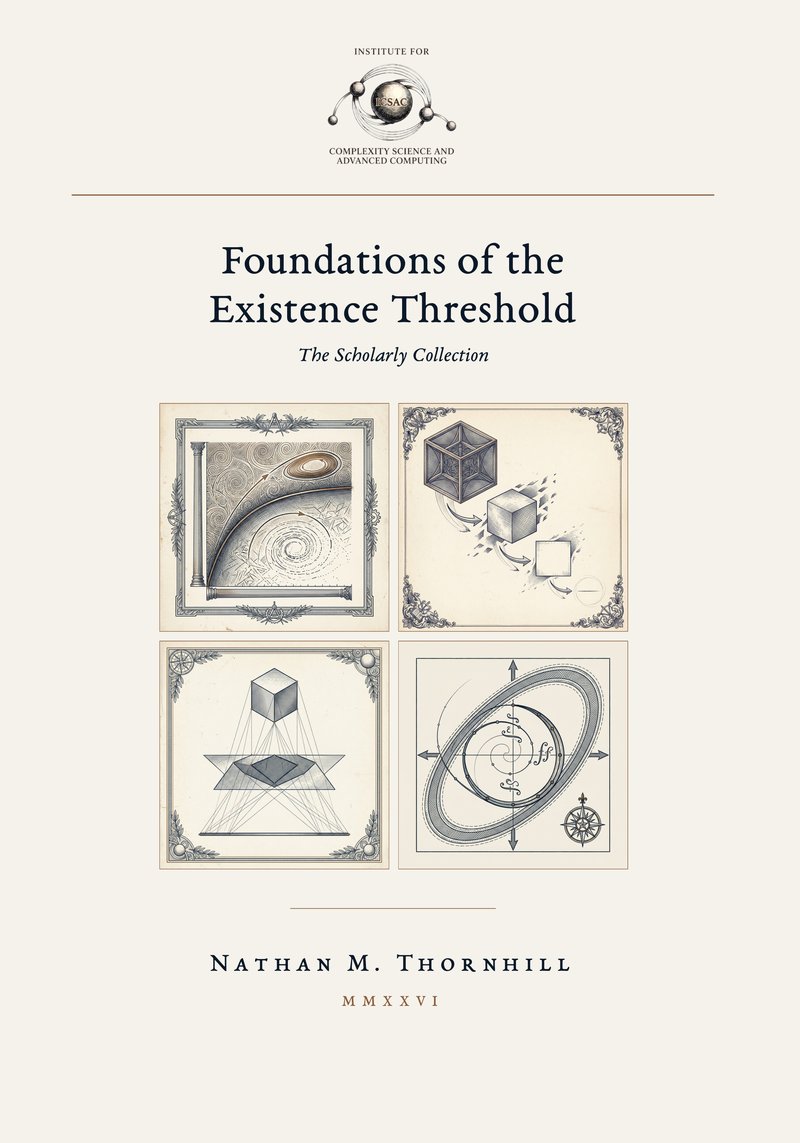
Foundations of the Existence Threshold — The Scholarly Collection
Nathan M. Thornhill, · Institute for Complexity Science and Advanced Computing
The collected volume. Four open-access papers — The Existence Threshold, the 86% Scaling Law, the Dimensional Loss Theorem, and the Dynamic Existence Threshold — joined by three original bridge essays and front matter that trace the framework from binary discrete systems through dimensional embedding to dynamic Phi. 100 pages, 7×10 trade paperback. ISBN 979-8-9958925-0-2 · LCCN 2026941912.
The Internal Dynamics of Decisions — From Rats and Primates to AI
Nathan M. Thornhill, · preprint, version 2 (October 2026) · Preprints.org
Whether the dynamics that carry a decision to commitment differ between the recurrent circuits of the brain and the transformer networks of large language models is a question about internal dynamics. For any recurrent network there is a feedforward network with matched behavior, so claims resting on internal dynamics must be tested directly. A dynamics demix separates input-driven change from change generated by a population’s own dynamics. Validated first on synthetic systems and checked against the mean-field variance theory of driven echo-state networks, it was applied to cortical populations in perceptual and value-based decisions and to five feedforward transformer language models constructing multi-step answers. Every neural dataset was autonomous-dominated and the five language models were input-dominated; under inference, orbitofrontal cortex recruited its autonomous component on both read-outs (24 of 31 rats on the variance partition), whereas four of the five models did not. For the two models and the cortical dataset re-examined at a matched input dimension of eight, the direction of that difference held. The models’ regime label, however, depends on the dimension of the input basis, so the difference is reported as one of regime at matched input dimension rather than as categorical. After commitment to a perceptual decision the cortical autonomous dynamics became more persistent, more sharply when aligned to the inferred commitment time than to stimulus onset (a specificity supported rather than established); this recovers a transition already reported for these recordings. In the two language models probed layer by layer the correct answer, when detected, first became top-ranked before the output layer, under the read-out used; across generated tokens, no commitment-locked rise in autonomous persistence was found in any model. In a pre-registered control varying only architecture at matched accuracy, the eigenvalue measure separated recurrent from feedforward networks, most cleanly when no input followed the evidence; that control, not the cortex–model comparison, carries the architectural claim. Pre-specified negative tests in orbitofrontal cortex found no commitment signal of the predicted sign in trial-averaged or scalar read-outs. Conclusions are limited to the systems tested. No claim is made about phenomenal experience or machine sentience.
Cite the versioned DOI — the unversioned form does not resolve: Thornhill, N. M. (2026). The Internal Dynamics of Decisions: From Rats and Primates to AI. Preprints. 10.20944/preprints202608.1095.v2
Recursive Existence Threshold — Where Meaning May Live
Nathan M. Thornhill, · preprint
The substrate-neutral scalar that keeps getting proposed as a sufficiency index for consciousness is provably content-blind by construction: a photograph, white noise, and the word “TRUE” can be matched on density, lose the same organization scalar, and keep an identical 4/13 of their connectivity. So where does the information live that the scalar throws away? One pre-registered test, three substrates, three answers. In a transformer, factual truth is linearly decodable from the residual stream (AUC 0.83) while the scalar stays blind across all 29 layers. In the anaesthetized brain, which individual a recording belongs to decodes from leakage-controlled connectivity where the scalar sits at chance. In sleep, a recurrence measure survives residualizing the scalar out across five stage contrasts. A sufficiency predicate for consciousness cannot be a single global scalar — what it leaves out is multiply-realizable relational structure that a transformer’s residual stream and the brain’s thalamocortical loops both carry.
Two Parallel Lines of Evidence. A synthesis note recording the chronology of two independent lines of evidence that converge on architecture-independent geometric fixed points as the principal explanatory mechanism for representational memory failure: the 86% Scaling Law (Thornhill 2026b) and the Dimensional Loss Theorem with GPT-2/Gemma-2 validation (Thornhill 2026c) from January 2026, and the Sentra production-embedding study (Barman, Starenky, Bodnar, Narasimhan, Gopinath, March 2026) reporting variance concentration to ~16 effective dimensions via participation-ratio methodology. The two bodies of work use different metrics and report different specific quantities, but converge on the same architecture-independent geometric explanation.
Integration-Differentiation Balance Predicts System State Across Substrates. A cross-domain framework for detecting organizational dissolution. Demonstrates that a structural coupling metric (Integration-Differentiation balance) separates consciousness states at AUC 0.91 across 136,394 EEG recordings, convergent with a simpler spectral baseline on the same task and has been applied to financial markets, space weather, and neural data.
A physicalist framework for understanding consciousness through information thermodynamics. Establishes the theoretical conditions that define the boundary between existence and non-existence, exploring how systems maintain coherence against entropy.
The first quantitative measurement of information loss at dimensional boundaries. Measures a consistent 86.01% ± 2.39% information loss across the tested cellular automata systems, with weak scale-dependence across grid sizes.
A formal mathematical theorem describing the mechanisms underlying information loss during dimensional reduction. Provides the theoretical foundation for understanding how patterns persist—or fail to persist—across dimensional boundaries.
Citations to retracted works in the OpenCitations Index — joined to the Retraction Watch database
Nathan M. Thornhill, · dataset · Harvard Dataverse · CC BY 4.0
The July 2026 release of the OpenCitations Index joined to the Retraction Watch database, with the scripts that built the join. 12 files, CC BY 4.0. It reports 999,842 citations pointing at 46,425 retracted papers, of which 330,834 were made after the retraction date. This is a dataset, not a paper; cite it as a dataset. Retraction Watch data is used with credit under their stated terms; Retraction Watch does not endorse or comment on work built on it, and no affiliation is implied.
Five minutes, pre-recorded, at AIMOS 2026, the annual conference of the Association for Interdisciplinary Meta-Research and Open Science (AIMOS), at Te Herenga Waka – Victoria University of Wellington, New Zealand, November 30 to December 2, 2026. The talk joins every retraction in the Retraction Watch database against the OpenCitations Index. Of 999,842 citations pointing at a retracted paper, 330,834 were made after the retraction date. Every number comes out of a public deposit at Harvard Dataverse, CC BY 4.0. Retraction Watch data is used with credit under their stated terms; Retraction Watch does not endorse or comment on work built on it, and no affiliation is implied.
A poster at The Science of Consciousness 2026, Paradise Point Resort, San Diego, California, October 11 to 16, 2026. I was at the board for Poster Session 1 on Tuesday, October 13. It’s the same study behind the Brain, or AI model? talk below: rat cortex, primate cortex, and AI models, and whether they commit to a decision the same way. The full write-up is the preprint, so cite that, not the poster.
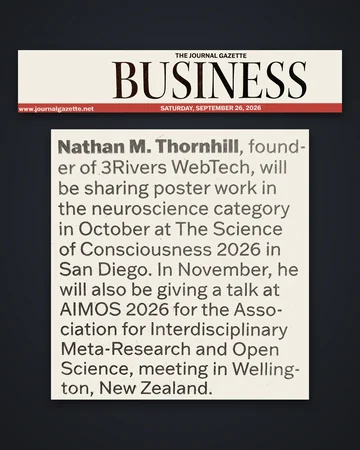
The Journal Gazette · September 26, 2026 · news brief, Business People column
“Nathan M. Thornhill, founder of 3Rivers WebTech, will be sharing poster work in the neuroscience category in October at The Science of Consciousness 2026 in San Diego. In November, he will also be giving a talk at AIMOS 2026 for the Association for Interdisciplinary Meta-Research and Open Science, meeting in Wellington, New Zealand.”
By Brian O’Connell. One of four outside experts quoted on whether AI token spend measures productivity: “It’s the top of their range, and their own numbers put the middle of the pack about ten times lower.” Syndicated by Yahoo Finance.
Consciousness, complexity, and the math of what persists. New papers, working notes, and the occasional argument with the field — straight to your inbox.